Build with us
Our Businesses Belong to Us
Our businesses are built from years of work, relationships, decisions, promises, and risk. Our data is the living record of what we own, who we serve, how we operate, and everything that has happened along the way.
Too often, that record does not live with us. It sits on servers we have never seen, inside systems we cannot open, under a business model that charges us every month for continued access.
First, the model makes it easy to move in. Then it makes it expensive to leave. Get the data in. Make the exit costly. Raise the price a little at a time, until we are standing outside our own front door asking to be let in.
Building software is getting cheaper. That should make switching easier. Instead, the data has become the moat.
So the model holds on tighter. It does not cut the rent; it raises it. It sells us AI that reads our own books back to us, one query at a time, for a fee. The lock is the last thing it has to sell, so the lock is what it charges for.
It needs us to forget that the data is ours.
This business model is older than software. For centuries, people across Europe could grow their own grain yet still be required to grind it at the lord's mill and pay for the privilege. The grain was theirs, but the machinery, the rules, and the price belonged to someone else. SaaS brought the lord's mill back.
We build and run these businesses. Ownership should mean something.
Ownership means:
- We can run the system on hardware we control.
- We can open it and see how it works.
- We can read our own database, all of it, without asking.
- We can leave without rebuilding the business from a broken export.
- Our access to our own history does not depend on a vendor keeping an account open.
We keep the records on machines we control. We put the new software to work on our side of the door. We stand on ground no one can reprice or shut off from a room we will never sit in.
Own it. The real thing. The database. The history. The working system around it. On our disks. In our hands.
Take it back.
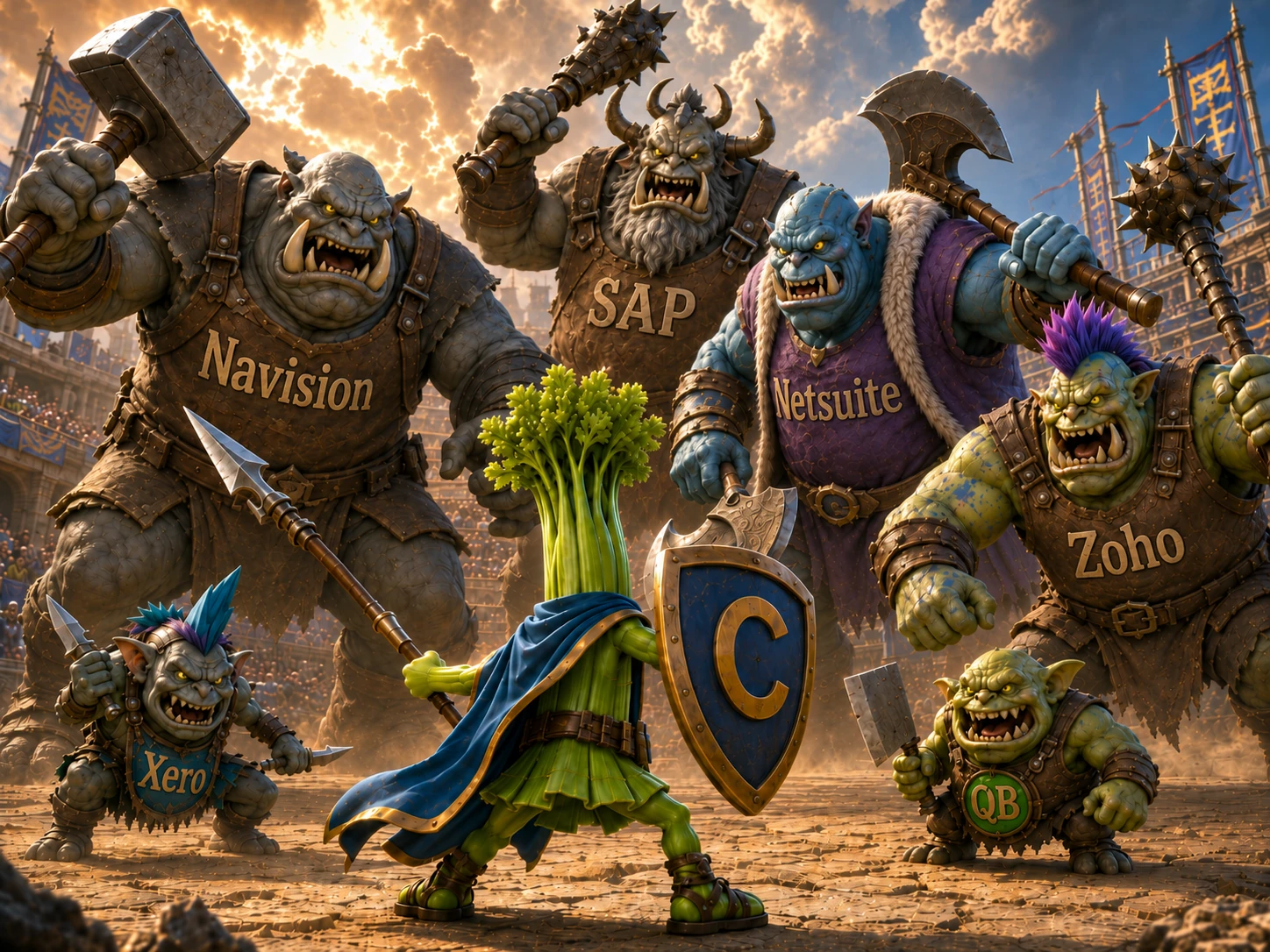
The illustration depicts a newcomer confronting the established ERP industry. Appearance in it does not attribute the practices described above to any named vendor.
Legal disclaimer: This image is satirical. Celerp does not claim that any named vendor is a mythological creature, levies tariffs on its subjects, or has proposed settling the matter through armed combat. No affiliation or endorsement is implied.
If you believe businesses should own the systems they depend on, star Celerp on GitHub. It helps more people find the project.
★ Star Celerp on GitHubOwning the system should mean you can change it.
“My vision for Celerp is that anyone with AI coding tools can describe what their business needs and get a module that imports right into the system.”
Celerp is how we put this into practice
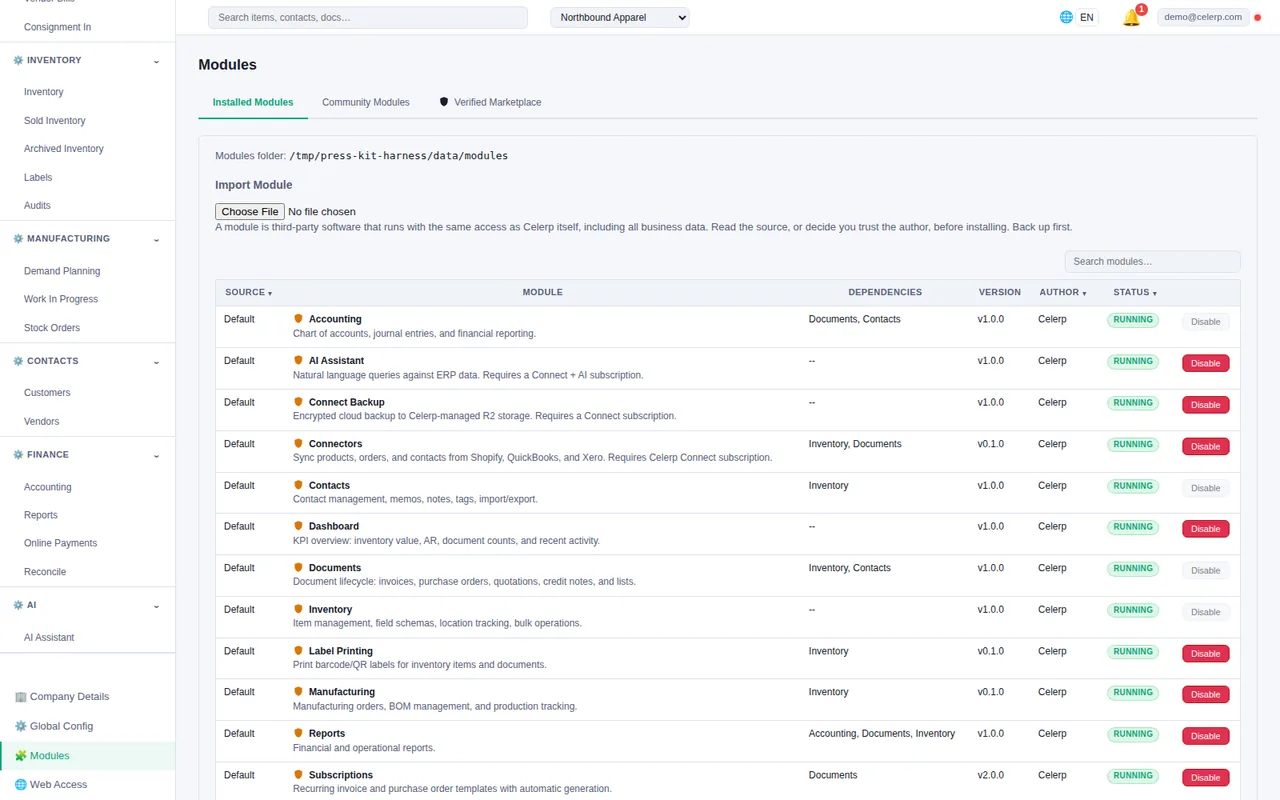
Celerp, in one breath
Celerp is a local-first business platform designed for non-technical teams to deploy on ordinary hardware and built to scale with mid-sized and large organizations. Preconfigured setups cover complete business cycles, enabling rapid deployment without dependence on outside consultants. Its MIT-licensed core modules include accounting, contacts, sales, inventory, supply chain, and manufacturing, and continue working offline.
Celerp is modular and built primarily in Python with FastHTML, making it straightforward to inspect, extend, and adapt. Your data remains in a PostgreSQL database and file store you control. Self-host the system, inspect the source, and retain direct access to the database beneath it.
How it stays alive
Celerp is free to run locally. Optional Connect, AI, hosting, and a planned module marketplace sustain the work.
The paid services have to earn your money. The software does not get to hold your data.
Licensing: MIT-licensed business modules; a source-available engine that converts to Apache 2.0; and source-available UI. See the complete license map.
Build on Celerp
Every business feature is a module on the same module API you use to build your own. Extend Celerp to a new industry, or fit it to how your business already works. Keep what you build private, or share it with everyone.
Follow the work
Watch Celerp on GitHub for releases, or follow Celerp Updates as the project develops.